Any aspiring woodworker will benefit from understanding an important set of properties of wood that are not obvious on the surface. These properties are not present in most materials that you would create with and indicate special consideration and practices for success. Wood can be a trickster if you do not understand it’s once living side.
15 Tools and Equipment Every Serious Woodshop Should Have
If you're looking into the woodworking business, or serious hobby work, there are some workshop tools and equipment that you'll need to own. The following machines are in order of most to least essential, followed by portable power tools. You actually can start with portable tools and do some good work, but this article is about fully equipping a small shop.
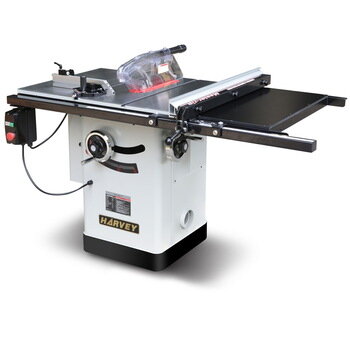
Table Saw
The table saw is central to the woodshop. They range in size and cost from very large production machines to small portable versions suitable to carry to a job site. All of them work in basically the same way.
A motor is mounted beneath a steel tabletop that holds a circular saw blade on a spinning shaft extending from the motor called an arbor.. The motor and blade can be tipped to an angle to cut a bevel cut along the length of a board. The machine also is equipped with an attachment called a miter gauge that rides in a slot on the steel top to guide cuts across the board. Lengthwise cutting is called ripping, and cutting the narrow direction is called crosscutting.
Jointer
This tool is used in conjunction with a Thickness Planer. It flattens and smooths the face of boards that are warped or twisted prior to sending them through the Planer to produce a given thickness. The jointer is also used to straighten edges before taking them to the table saw to cut them to a given width.
Thickness Planer
The thickness planer is another very important tool no woodshop should be without. After the lumber is made flat on one face the planer will take it down to the desired final thickness and produce a smooth face.
Like the jointer, the planer has a spinning cylindrical cutter head with straight knives. As the wood is fed into the machine it is picked up by power feed rollers that carry it under the cutter head to produce the desired thickness.
Compound Miter Saw
This tool is designed for crosscutting and can simplify such cuts compared to the table saw. Since the wood is what moves on the table saw, sufficient clearance for making crosscuts can be difficult. The miter saw almost always is set against a wall and the wood simply dropped down and cut.
This is a portable tool but because of how it works, it’s highly recommended you use it with an extended table on the front and back for extra stability. This is not only for the saw, but it’s also for the material being cut. Some pieces can be quite long.
The saw itself is a circular saw mounted on a table with an arm that has a rear pivot. Blades are between 8 and 15 inches in diameter with most jobs needing 10-12 inches. The diameter determines the max-width of the cut. The blade and motor can be tilted to one side together for miter cuts and the blade alone can be titled again allowing for the compound miter cut. A compound miter cut is two different angles being cut at the same time.
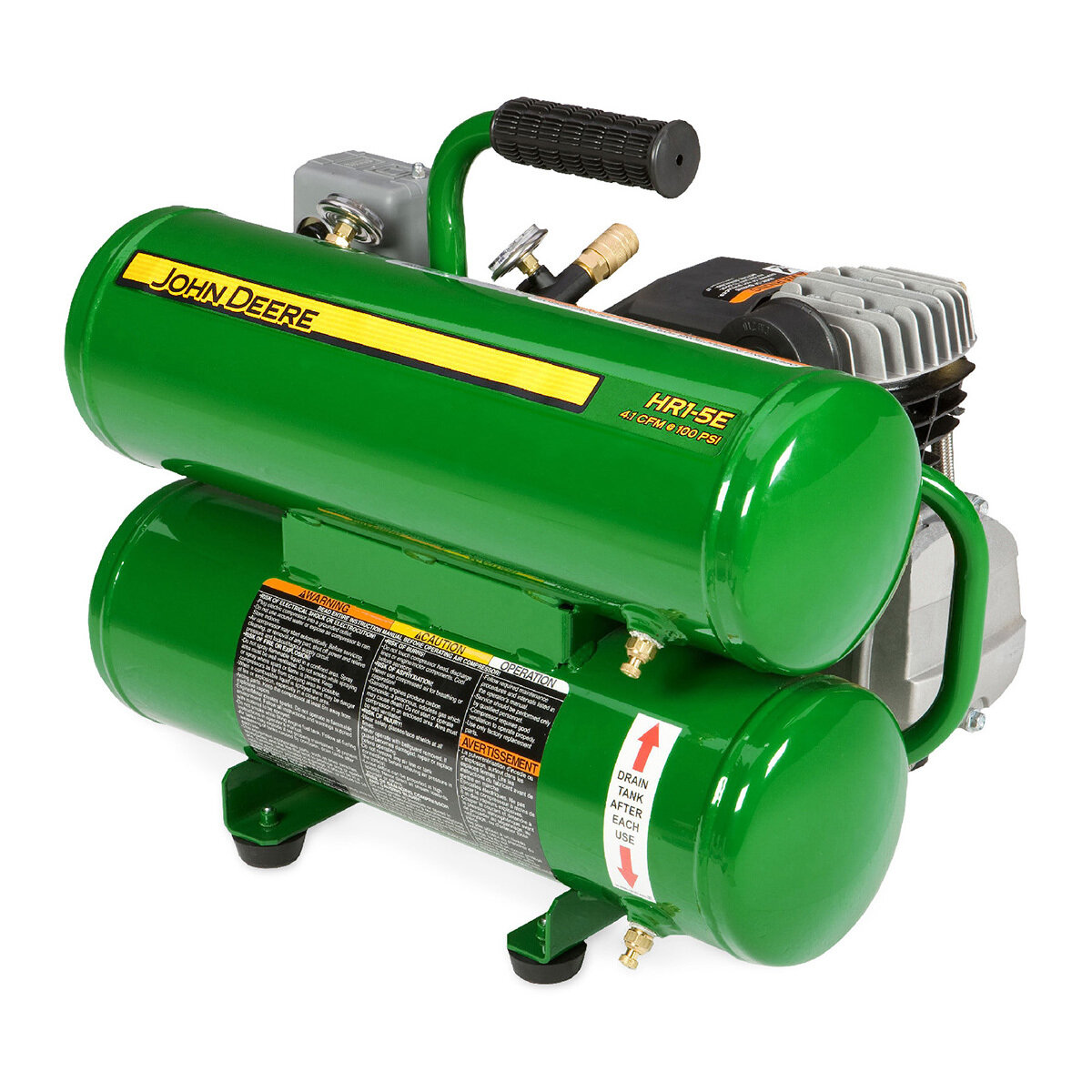
Air Compressor
In this day and age where most tools are powered, this has become one of the most important pieces of equipment in any kind of shop but especially the woodshop.
It is usually a round tank full of compressed air with a set of regulators. One regulates the pressure in the tank, and the other regulates the pressure of the air leaving the tank typically via a hose. There’s also a motorized pump and the necessary power switch. Everything is then housed in a metal frame with or without wheels and a handle.
Drill Press
The drill press is akin to a portable drill, except the drill itself is built into an assembly that controls the movement of the drill bit in a constrained vertical direction while the material is placed on a table below the drill bit.
The drill press comes in two models, the free-standing floor model and the portable one you can mount on your workbench. The drill press has a fixed motor and a pulley system to transfer rotation to a vertical shaft. The vertical shaft carries a drill chuck designed to clamp a variety of sizes of drill bits extending out of the bottom end of the shaft.
There is a lever arm that is moved in a circular fashion to lower the shaft and drill bit into the wood. It is spring loaded to allow the shaft to return to the top position when the lever arm is released
Like a hand drill, it has a chuck where you attach either drill or driver bits. Once it’s secured, you use the lever to lower the chuck to the workpiece. Once it’s done, you release the level, and a spring sends the chuck back up again. The table is adjustable to the size of the workpiece.
Band Saw
The “band” of a band saw is the blade which is a long hoop of metal with teeth along one edge. The blade is looped over two wheels one above the saw table and one below the saw table. The wheels are pressed apart to tighten the blade hoop against the wheels and provide considerable tension to the section of the blade that is vertical from one wheel to the other. The body of the band saw is basically a C shape designed to hold the two wheels, the table, and a motor on the lower wheel to drive the blade.
Disk and Belt Sander
This is a two for one combo tool. It has a stationary disc sander set up vertically on one side, and a stationary belt sander set up horizontally on the other side. Between them there is and electric motor and a pair of round drums. One drum runs the motor for both sanders while the second drum keeps tension on the belt sander.
The belt sander uses sandpaper in a wide variety of grit as well as width and length. The disc sander uses discs that come in a large assortment of sizes with the most commonly used sizes being 4-8 inches in diameter.
Circular Saw
This saw is one of the best for a beginner just learning how to cut wood. It can handle rip cuts, bevels, and cross-cutting with ease. This tool can be handheld or mounted to your workbench. Most use it with a pair of sawhorses to hold the wood to be cut. The blade can be adjusted for depth so the user can cut dados, cut-offs, and narrow slits.
The mobility and versatility of being hand controlled help it to be a quick way to make a cut that does not need high accuracy. It is a table saw without the table.
Power Drill
A drill should be owned by everyone, not just woodworkers. It’s very versatile when it comes to fastening screws or boring holes. A handheld drill can be converted into a press drill when you need one. It has a chuck for holding all manner of drill and driver bits, and it can be used anywhere.
Jigsaw
This tool is a hand held power tool designed to make curved cuts. The piece of work is held stationary, usually in clamps. Blades extend out of the bottom of the saw’s foot and reciprocate up and down to make the cuts
Router
This hand tool has a huge selection of bits to fit practically any type of job the customer (or spouse) wants from you. It’s mainly used for hollowing out circular areas on the face of wood, but like the scroll saw, it can also be used for cutting dovetails and dados, adding profiles to crown molding, cutting patterns on the face of wood, and adding decorative edges.
Shop Vacuum
This piece of equipment is a major must-have for cleaning up your woodshop. Made almost completely of plastic, this vacuum doesn’t use a bag. It can be used to pick up everything from nails and screws to oil.
The takeaway
As important as these tools are, the budget required to purchase this equipment is out of the question for most people. This is where renting space and accessing these tools makes all the difference. IsGoodWoodworks offers competitive shop and equipment rental rates along with a variety of training and certification programs.
This is the perfect solution for anyone looking to save money but wants access to premium grade equipment in a large, efficiently designed shop.
How to Find a Good Woodworking Shop Rental Fast
Finding a space for your woodworking business can feel urgent when you are eager to get started. Unfortunately, this is one of those areas of life where all too often, haste makes waste.
Eagerly snapping up the first space you see, not taking time to assess the location or the terms of the lease can lead to a lot of money spent for no good reason. Building owners and landlords are out to get the best possible deal for them, not for you.
Besides these, there are also a lot of scams in the real estate rental market — people who dishonestly collect money to rent out buildings they do not own. Never deal with anyone who cannot show you the inside of the space they are renting out and provide you with the key onsite.
As excited as you might be, you really do need to slow down a bit and consider some important things.
If renting your own woodworking shop is not feasible, you can take advantage of already set up woodworking spaces in your area so you can have access to premium grade equipment that startup shops typically don’t have the budget for. There are many other perks that come along with renting out space vs. starting your own shop.
Looking to rent out shop workspace? Check out our woodworking shop rental services.
Networking is Key
Most cities have a Chamber of Commerce. As an entrepreneur, it is in your interest to join your Chamber of Commerce and other merchants’ associations in your area. There you will find experienced business people who can help you to understand how the commercial rental market works, who is good to work with, and whom to avoid. Often, these people are also the first to be aware of a new space about to become available.
Pick the Right Neighborhood
It helps to drive and walk around the commercial districts of your city. See where potential competitors are located — it may help to be near your competitors so that shoppers looking for similar products to yours will see your shop. Also, think about what other products complement yours.
If you are a cabinetmaker, will your customers also be shopping for kitchen fixtures? If you make patio furniture, perhaps it would be advantageous for you to be near a nursery or garden center.
If you understand your customer base, you can leverage other businesses in the area that are likely to bring the right customers to your vicinity. It also helps to be near a major transportation route.
Of course, all this comes at a cost. The more desirable the location, the more you will be paying. Everyone likes to save money, but there is a point at which saving more will hurt you.
Customers will not want to come to a shop that is too far out of the way or in a neighborhood they perceive as dangerous. You need to factor this into your budget when searching for a location.
If you plan to locate in a rural area, it is even more important to locate on a major transportation route. In these locations, there may not be an adequate local customer base, and you will need to be visible to travelers passing through.
These need not be long-distance travelers; people from nearby cities, especially if they travel that route frequently, may consider your business to be within a reasonable distance from their homes, and come back specifically to see.
Do You Want to Work With a Broker?
This can be a good idea in many cases since a reputable broker will in turn work only with reputable landlords, and brokers have access to listing databases that can show you many more potential locations than you could find on your own, even using
Craigslist or LoopNet. A good broker also has the leverage to help you negotiate the lease terms so that you are not at the landlord’s mercy.
Of course, this, too, comes at a cost — brokers will charge 7 to 10% of the lease cost. Still, the National Association of Realtors or your state’s realtor association is a good place to look for a reputable broker.
Is This Starting to Feel Expensive?

Yes, “It takes money to make money,” but realistically, you might not feel that you have the resources as a startup to pay a broker’s fees, monthly rent, deposit, and assorted other costs.
You might be considering setting up shop in your garage. If you have a garage, that can be a viable option, but there are certain considerations. Most garages will need modifications before they can be properly used as woodworking shops.
Woodworking shops produce two main nuisances, noise and dust. Noise abatement can be achieved by installing a drop ceiling with sound insulation.
If this renovation has not been done, can you afford to do it? A dust collector hung from the ceiling will help with the dust. Then, too, you will need to account for the electricity your tools use. Are there enough outlets? Will you need a lot of extension cords?
Another reality of life is that not everybody lives in a house with a garage. If you live in an apartment complex, you probably cannot have a home-based woodworking shop and will need to find an offsite location.
A Good Way to Get Started
If you are a beginning woodworker, without an established reputation, it will take time to build up enough sales volume to afford your own retail space. But in the meantime, you still need a place to do your work.
Fortunately, there are options. You could buy space in an existing woodworking shop. This will allow you to share expenses with the other woodworkers using that shop, instead of covering all expenses by yourself.
Another option is to find a woodworking club where you can buy machine time. This carries a very low risk and low liability, and is a good option for beginners or those who are more interested in woodworking as a hobby. In that case, renting a space in a woodworking shop is ideal.
IsGood Woodworks offers shop space, machine time, and storage space for the aspiring woodworker. You can choose from several different plans — the ones that best fits your needs.
7 Reasons To Rent A Woodworking Shop
Should you own or rent your woodworking shop? There are pros and cons of both, of course, but you should consider that most homeowners choose to own as a long-term investment. That might not be the ideal strategy for your woodworking business, in which you make your money, not by holding long-term assets, but by producing and selling products. Here are some reasons why you might choose to rent instead of own.
1. Smaller Startup Capital
“It takes money to make money,” the saying goes. Every business venture requires an initial capital investment — in the case of woodworking, this includes your tools and equipment as well as your physical location. For a home-based woodworking business, a bare beginning machine set is easily $1500, and wood and other materials, another $2000. If this seems like a lot to you, consider what it costs to purchase a building.
Purchasing a property requires a sizable down payment, usually 20% of the total purchase price, as well as closing costs and agent fees over and above the purchase price. In contrast, renting business property (as opposed to residential) can have much lower upfront costs. For a beginning woodworker, the option to rent space in a shared workshop may reduce your startup costs even further, if there are major items of equipment already in place.
2. Lower Monthly Payments
You might already have needed to take out a business loan for your upfront business expenses. Why take out a mortgage in addition? Mortgages are typically for a term of thirty years, and in the beginning, you will be making payments more on the interest than on the principal. This means that it takes a while to build up significant equity. Depending on where you rent, you may find that your monthly rent payments are considerably less than mortgage payments would have been.
3. More Mobility
Suppose your business does not stay in the same location for thirty years? If you own your building, you must either find a buyer or a tenant before you can relocate. Renting out a building you own brings its own complication — it can be another business in itself. Do you have the time and desire to manage that venture alongside your woodworking business? What if your business outgrows its space, but you cannot find any buyer or tenant for the building you own?
You have to keep making the payments on it, while also paying for your new, larger space. If renting, you do not have this problem. You can vacate as soon as you find a new location, and your former landlord is then responsible for finding a new occupant. If for some reason you decide to close your business, the same problem applies if you own your building. But if your business was a tenant, you have less to liquidate, i.e. only your tools and movable equipment.
4. Shared Responsibility
Ask any homeowner how much time and money they spend on maintenance. Commercial and industrial buildings require maintenance as well. Since you probably do not have time to dedicate to this and your woodworking business at the same time, this means hiring a contractor whenever maintenance is required — whether repairing the plumbing or replacing rusty siding. This represents one more expense reducing your margins.
On the other hand, if you rent a building, your lease will specify who is responsible for what. The landlord is typically responsible for much of the exterior building maintenance. If you rent space in a shared workshop, the landlord will likely be responsible for maintaining the common spaces, as well. The money you are not spending on maintenance can be invested into your business instead, or put into saving for your long-term financial goals.
5. Tax Advantage
Depending on your particular situation, renting may prove to be a tax advantage. The interest payments on a commercial mortgage are deductible, but principal payments are not. By contrast, rent paid on a building used solely for your business is 100% deductible. After factoring in depreciation (if you own), the amount of your monthly payment, and your profits, you can determine whether renting or owning is the better choice, tax-wise.
How much of your tax burden can you offset with each option? Is the tax offset worth the expense? There is also the consideration that selling a building at a profit subject you to capital gains tax. This is not the case with selling a lease, unless you sell at a premium.
6. Location, Location, Location
Your business can attract more customers if it is located in an existing commercial/industrial area. These locations often have multi-unit buildings where you can rent just the amount of space you need in a building shared with other businesses. Obviously, this will cost less than having to purchase an entire building much larger than you need.
7. A Good Way to Get Started
If you are young, or just starting out as a business owner, you might not have the established credit or income stability that a mortgage lender is looking for. For a young person, renting one’s business space can be the best choice for the same reason that renting one’s living space can — the credit requirements are more likely to be within reach. It is important to remember that all business ventures start small.
The wise entrepreneur will not try to get too big too soon. Instead, it is far better to begin with modest goals, and this means considering carefully every expense, taking on only as much as you need at first. As your business becomes more profitable, then you can begin to consider upsizing.
Takeaway
Renting a woodworking shop can bring having a woodworking business within reach of many who would not be able to purchase a building. IsGood Woodworks offers several shop rental options, including monthly and per-use rates, which include access to storage space. There are bins of materials and supplies available free, which will help to reduce your costs. If you are looking to start up a woodworking business, this is a good place to get started.
DIY RV Bathroom Cabinets
I wrapped up the water closet cabinets for #1 Tiny House over a few days. I start by doing and teaching how to dress lumber for fine wood working. Making lumber flat, straight, and to accurate size is a very specific process. There are several good tips and tricks, including how to make miniature ball bungees to retain tall objects on open shelves.
Day 53 during the Covid-19 shut down. 5/10/2020
Tiny House/RV Roof DIY Build
The roof of #1 Tiny House travel trailer is herein completed. Are you looking to build well insulated energy efficient and cost effective Tiny House arched roof? Here is a great example that includes some good learning advice. How to fireproof, an easy finish for interior woodwork, repair friendly electrical fixture mounting and more.
Day 43 during my Covid-19 exile at IsGood Woodworks 4/30/2020
Steam Bent Window Trim
After a fairly long break, I am now finally returning to work on the flagship of my future fleet of tiny house style RVs, mostly travel trailers. I now begin the completion of the inside of the roof section, with curved trim for the skylight over the sleeping section.
Tiny House RV Walk Through
I have been eagerly awaiting the beginning of the end of 4 years of work on the flagship of my future fleet of RV’s. That time has arrived! The goal is to have all of the in shop work done before we re-open, and ready to move outside to unite the roof and the body. That will also have the significant benefit of opening up an abundance of space for my subscribers and short term shop users.
This is the first of a fleet intended to constitute a “retirement” business currently envisioned as a private outdoor touring company, fleet provided. It is not clear at this time regarding solo rentals. Feel free to tell me what you think about how best to make use of my future fleet.
Making a Spanner Wrench
When I first announced that we were required to close by the Gov’ners orders, I described what I would be doing and that included shop improvements. I got a very quick response from one of my long term subscribers: “Please.. Make…The...Spanner…Wrench.”. This was for Ossie, our oscillating spindle sander, that was a complete obstructionist jerk every time you needed to change the sanding cylinder.
Ossie has a whole new attitude:
Heirloom Crib
One of my subscribers was cut of by the shut down very near the completion of a long running fine piece of traditional woodworking: A cradle for the generations. He asked if I would complete it and I felt honored to do so. Not to waste any yield of value, it is now part of my story.